

THERMAL MODIFICATION
What is Thermal Modification?

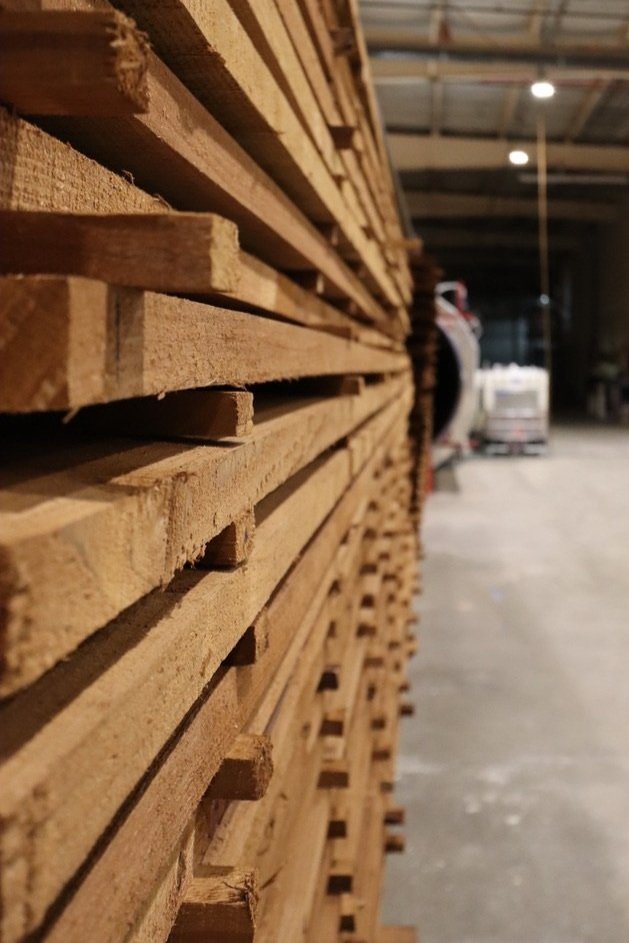
At the BIC (Building Innovation Center), our team uses the Maspell Kiln to thermally modify lumber. This advanced process involves subjecting the lumber to heat and vacuum within a vacuum-sealed environment, eliminating any risk of fire.
Temperatures slowly increase to a peak of 400°F before entering a cooling phase spanning three days. The wood deepens to a rich chocolate brown, serving as a visual testament to its enhanced durability.
Within the core of the lumber, metamorphosis occurs, transcending mere surface alterations. Sugars and starches meld into a protective caramelized shield, fortifying the wood against termites and other invasive pests. Simultaneously, the cellular structure undergoes strengthening, enhancing its water resistance.
Our lumber is locally sourced from the Makah Tribe where 30,000 acres of Coastal Western Hemlock reside.

BENEFITS
-
By reducing natural sugars, thermal modification makes the wood less susceptible to decay and termite activity.
-
By removing moisture from wood cells, thermal modification improves dimensional stability, helping the wood maintain its shape and resist warping when exposed to moisture.
-
While lifespan varies by species and application, thermal modification typically extends the service life of wood products, with common estimates around 25 years.
-
Thermal modification stabilizes the wood’s cellular structure, reducing susceptibility to warping and cracking caused by changes in humidity.
-
Thermally modified wood provides enhanced thermal and acoustic insulation, making it an excellent choice for paneling in spaces like music studios where both aesthetics and performance matter.
-
Thermal modification is a chemical-free process that uses only heat and vacuum, ensuring the wood remains additive-free. When combined with responsibly sourced timber from partners such as the Makah Tribe, this approach reinforces the product's sustainability.